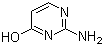
DNA's familiar four-letter alphabet depends on the arrangement of atoms, not simply on a collection of nitrogen-containing rings. Isocytosine makes that distinction unusually clear. It contains the same numbers of carbon, hydrogen, nitrogen and oxygen atoms as cytosine, but its amino and oxo functions occupy different positions on the pyrimidine framework. The rearrangement changes the pattern of sites that donate or accept hydrogen bonds. Two compounds can therefore share a molecular formula while presenting different recognition surfaces to a partner.
The free base, registered as CAS 108-53-2, is commonly described as 2-amino-4-hydroxypyrimidine or an aminopyrimidinone. These names reflect alternative ways of representing a tautomeric heterocycle. Movement of a proton, accompanied by redistribution of double bonds, can change whether a particular atom behaves as a hydrogen-bond donor or acceptor. Protonation introduces another variable. For molecular recognition, the relevant structure is consequently the form present under the experimental conditions, rather than an isolated drawing in a catalog.
Isocytosine became particularly interesting in attempts to expand the genetic alphabet. Natural DNA normally uses adenine, thymine, guanine and cytosine. Researchers asked whether alternative hydrogen-bonding patterns could create an additional complementary pair while retaining a geometry compatible with a nucleic-acid helix. Isocytosine and isoguanine supplied one important test of that idea. Their intended pairing rearranges the recognition pattern of the natural guanine-cytosine pair without abandoning the broad purine-pyrimidine size relationship.
A landmark appeared in 1989, when Christopher Switzer, Simon Moroney and Steven Benner reported polymerase-directed incorporation of isoguanosine opposite isocytidine in a DNA template. The work examined both DNA and RNA polymerases. A fuller account published in Nature in 1990 described enzymatic incorporation of the additional pair into DNA and RNA. These experiments helped move an expanded alphabet from a proposal about hydrogen bonds to an experimentally accessible question about enzyme recognition. They did not establish that every artificial base pair could be copied indefinitely with natural biological fidelity.
The distinction between a base and a nucleotide is central to understanding those results. Isocytosine is the heterocyclic component. Isocytidine adds a sugar, and a nucleotide adds phosphate functionality. Polymerases act on appropriately constructed nucleotide substrates and templates, not on a bottle of the free base. The position and orientation of sugar attachment also matter because a recognition surface must be displayed correctly inside a duplex. A finding about an isocytosine-containing nucleic acid is therefore a use of its molecular framework, rather than evidence that the free compound itself stores genetic information.
Several physical requirements must be satisfied together. A pair must fit the helix, stack with neighboring bases and distinguish its intended partner from competing natural bases. An enzyme must then accommodate the substrate and catalyze bond formation. Tautomerism makes that problem more subtle: a minor form can expose a different recognition pattern even when the predominant form looks promising. This is why measuring molecular association and demonstrating enzymatic copying answer related but different questions.
A useful experimental comparison holds some features constant while changing another. Here the atomic inventory is conserved while the recognition edge changes. That makes isocytosine an unusually economical way to separate composition from connectivity in a biological question.
Isocytosine also provides a compact model for studying hydrogen bonding, proton transfer and interactions of nucleobase-like molecules with metal ions. Its scientific importance lies in making molecular recognition experimentally adjustable. A modest rearrangement of familiar functional groups helped researchers test which features of genetic chemistry are necessary and which can be redesigned.
References:
1. PubChem. Isocytosine, CID 66950; CAS 108-53-2. https://pubchem.ncbi.nlm.nih.gov/compound/Isocytosine
2. Switzer C, Moroney SE, Benner SA. Enzymatic incorporation of a new base pair into DNA and RNA. J Am Chem Soc. 1989;111:8322-8323. DOI: 10.1021/ja00203a067. https://doi.org/10.1021/ja00203a067
3. Piccirilli JA, Krauch T, Moroney SE, Benner SA. Enzymatic incorporation of a new base pair into DNA and RNA extends the genetic alphabet. Nature. 1990;343:33-37. DOI: 10.1038/343033a0. https://doi.org/10.1038/343033a0
|






 GHS07 Warning Details
 chemBlink Chemical Story