
Online Database of Chemicals from Around the World
| BOC Sciences | USA | |||
|---|---|---|---|---|
 | www.bocsci.com | |||
 | +1 (631) 485-4226 | |||
 | +1 (631) 614-7828 | |||
 | info@bocsci.com | |||
| Chemical manufacturer | ||||
| chemBlink Standard supplier since 2010 | ||||
| Finetech Industry Limited | China | |||
|---|---|---|---|---|
| www.finetechchem.com | |||
| +86 (27) 8746-5837 +86 18971612321 | |||
| +86 (27) 8777-2287 | |||
| sales@finetechnology-ind.com | |||
 | QQ Chat | |||
| Chemical manufacturer since 2009 | ||||
| chemBlink Standard supplier since 2019 | ||||
| Changzhou Jiuwu Chemical Co., Ltd. | China | |||
|---|---|---|---|---|
| www.jiuwuchem.com | |||
| +86 (519) 8512-1086 +86 13775162768 | |||
| +86 (519) 8512-5369 | |||
| info@jiuwuchem.cn | |||
| QQ Chat | |||
| Chemical manufacturer since 2009 | ||||
| chemBlink Standard supplier since 2023 | ||||
| Classification | Pharmaceutical intermediate >> Heterocyclic compound intermediate >> Pyridine compound |
|---|---|
| Name | (alphaS)-alpha-[[(9H-fluoren-9-ylmethoxy)carbonyl]amino]-1H-Pyrrolo[2,3-b]pyridine-3-propanoic acid |
| Synonyms | (2S)-2-(9H-fluoren-9-ylmethoxycarbonylamino)-3-(1H-pyrrolo[2,3-b]pyridin-3-yl)propanoic acid |
| Molecular Structure | 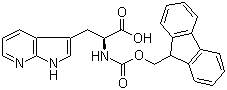 |
| Molecular Formula | C25H21N3O4 |
| Molecular Weight | 427.45 |
| CAS Registry Number | 737007-45-3 |
| SMILES | C1=CC=C2C(=C1)C(C3=CC=CC=C32)COC(=O)N[C@@H](CC4=CNC5=C4C=CC=N5)C(=O)O |
| Density | 1.4±0.1 g/cm3 Calc.* |
|---|---|
| Index of refraction | 1.695 (Calc.)* |
| * | Calculated using Advanced Chemistry Development (ACD/Labs) Software. |
| Hazard Symbols |  GHS07 Warning Details |
|---|---|
| Risk Statements | H315-H319-H335 Details |
| Safety Statements | P261-P305+P351+P338 Details |
| SDS | Available |
 chemBlink Chemical Story
|
Replacing one aromatic carbon-hydrogen unit with nitrogen can turn an amino-acid analogue into a useful optical reporter. Fmoc-L-7-azatryptophan, CAS 737007-45-3, supplies that modification in a form intended for peptide synthesis. Its long systematic name describes the same pyrrolopyridine-containing amino acid, rather than a separate fluorescent dye attached to ordinary tryptophan. The side chain contains a 7-azaindole ring system. Relative to indole, a CH unit in the six-membered ring has been replaced by nitrogen, while the pyrrolic N-H remains. The added nitrogen changes the ring's electronic and hydrogen-bonding properties. It does not mean that an extra amino group has simply been appended to the outside of the ring, and it is not the same modification as adding a methyl group or chlorine at position 7. The alpha-amino nitrogen carries Fmoc, and the carboxyl group remains an acid for coupling. Introducing the residue into a peptide and removing the appropriate protection produces a molecular environment different from that of the isolated protected reagent. This distinction is particularly important for optical measurements because the aromatic Fmoc group can itself contribute to a protected compound's spectroscopic behavior. The scientific context is the fluorescence of tryptophan analogues. Native tryptophan already provides an intrinsic optical signal in proteins, but an analogue can shift the observable response and make selected sites easier to investigate. A reporter residue is useful when its measured signal can be related to a change in surroundings or molecular interaction. Its value depends on calibration and the system being studied, rather than on the mere presence of an aromatic ring. A 2019 study in Organic & Biomolecular Chemistry investigated a peptide-based fluorescent probe for biological heme monitoring. The authors incorporated 7-azatryptophan and observed fluorescence quenching upon hemin addition. This is a concrete example of an incorporated analogue contributing to a designed probe. It does not establish that the isolated Fmoc-protected amino acid has the same response or is a validated clinical diagnostic reagent. Quenching means that the observed fluorescence decreases under the tested conditions. It is not automatically a unique signature of one binding event: absorption by another component, changes in concentration, and other photophysical processes can also alter intensity. A useful probe experiment therefore needs controls that distinguish the proposed molecular interaction from alternative explanations for a dimmer signal. The peptide sequence contributes another level of specificity. It can help present the reporter and provide interactions with the target, while the local environment changes the optical response. Keeping the reporter at a known sequence position allows more focused comparisons than a mixture with uncontrolled labeling sites. Nevertheless, changing a native residue can also affect the molecule being studied, so minimal structural change should not be confused with proof of zero perturbation. Intensity and fluorescence lifetime offer different views of the reporter. Intensity concerns how much light is detected, while lifetime describes the timing of emission after excitation. Neither quantity should be substituted for the other, and using an optical label does not remove the need to define exactly which observable an experiment measures. Fmoc-L-7-azatryptophan thus connects synthetic control with spectroscopic observation. The protected building block provides a defined way to place an unusual aromatic residue, and the final peptide provides the environment in which its signal becomes informative. The central achievement is not simply making a molecule fluoresce, but designing an experiment in which a measured change in light can answer a specific molecular question. References: 1. Echo Biosystems. Fmoc-L-7-AzaTrp-OH; CAS 737007-45-3. https://www.echobiosystems.com/fmoc-l-7-azatrp-oh.html 2. Development of a peptide-based fluorescent probe for biological heme monitoring. Organic & Biomolecular Chemistry (2019). https://doi.org/10.1039/C8OB02290A |
| Market Analysis Reports |