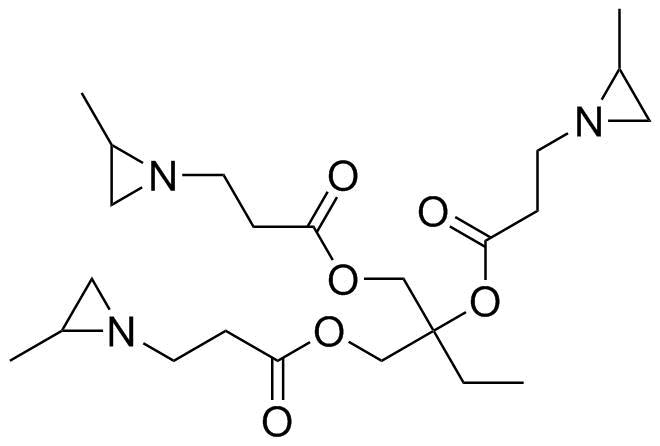
Trimethylolpropane tris(2-methyl-1-aziridinepropionate) is a crosslinker built around three highly strained aziridine rings. Its usefulness and its hazard arise from the same feature. A three-membered nitrogen heterocycle stores ring strain and reacts readily with suitable nucleophiles. Attach three such groups to one compact core and the molecule can connect several polymer chains, converting a waterborne coating from a soft linear material into a chemically resistant network.
Many waterborne acrylic and polyurethane dispersions contain carboxylic acid groups that help stabilize the polymer in water. When a polyaziridine is added, an aziridine nitrogen can first be protonated by a carboxylic acid, making the ring more susceptible to nucleophilic attack. Ring opening then forms a new covalent bond. Because CAS 64265-57-2 carries three aziridine functions, repeated reactions can link separate polymer chains and raise crosslink density.
The macroscopic effect is important. Crosslinking can improve resistance to water, solvents, chemicals, abrasion, and blocking, and can strengthen adhesion to difficult substrates. Classical multifunctional aziridines therefore became effective two-component additives for inks, adhesives, and coatings, particularly where a waterborne polymer must approach the durability of a solventborne system. The price of high reactivity is limited pot life after mixing: once crosslinker and resin are combined, the formulation is no longer indefinitely stable.
The more serious limitation is toxicological. Modern coating research explicitly identifies trimethylolpropane tris(2-methyl-1-aziridinepropionate) as a classical, very active polyaziridine crosslinker with an unfavorable genotoxic profile. That has driven development of higher-molecular-weight and differently substituted aziridine systems intended to retain crosslinking performance while reducing biological reactivity and exposure. This is a valuable example of safer-by-design chemistry: replace a technically successful molecule not because it fails at its job, but because its hazard profile is no longer acceptable.
Crosslinking also changes the economics of waterborne coatings. Water can replace much of the volatile organic solvent, but the dried film may initially retain hydrophilic groups needed for dispersion stability. A post-application crosslinker can convert some of those polar, water-sensitive sites into network junctions after film formation. This separation between "stability in the can" and "durability on the substrate" is why two-component chemistry is so useful. The crosslinker is asked to remain manageable long enough for application, then deliberately destroy the polymer mobility that made processing possible.
The compound therefore tells a two-sided materials story. Ring strain makes aziridines excellent chemical switches for building dense polymer networks, yet the same electrophilic reactivity can be problematic in biology. Modern materials chemistry increasingly has to optimize both functions at once. A crosslinker is not truly high performance if the coating becomes tougher but the people making and applying it face avoidable molecular hazards.
References:
1. Buckmann AJP et al. Journal of Coatings Technology and Research. 2022;19:1345-1355. DOI: 10.1007/s11998-022-00626-w.
2. WO2021148561A1. Aziridine functional compound with reduced genotoxicity.
3. Patent literature identifying CAS 64265-57-2 as a classical polyfunctional aziridine crosslinker.
4. ECHA and industrial safety documentation for multifunctional aziridines.
|







 GHS07 Warning Details
 chemBlink Chemical Story