Online Database of Chemicals from Around the World

Pentafluorobenzoic acid
[CAS 602-94-8]

List of Suppliers
Simagchem Corporation China
www.simagchem.com
+86 13806087780
+86 (592) 268-0237
sale@simagchem.com
Chemical manufacturer since 2002
chemBlink Standard supplier since 2008
BOC Sciences USA
www.bocsci.com
+1 (631) 485-4226
+1 (631) 614-7828
info@bocsci.com
Chemical manufacturer
chemBlink Standard supplier since 2010
Beckmann-Kenko GmbH Germany
www.beckmann-kenko.com
+49 (4241) 930-888
+49 (4241) 930-889
info@beckmann-kenko.com
Chemical distributor
chemBlink Standard supplier since 2011
Fluoropharm Co.,Ltd. China
www.fluoropharm.com
+86 (571) 8558-6753
+86 13336034509
+86 (571) 8558-6753
sales@fluoropharm.com
QQ Chat
Chemical manufacturer
chemBlink Standard supplier since 2013
Shanghai PI Chemicals Ltd. China
www.pipharm.com
+86 (21) 58953700
+86 (21) 58953701
sales@pipharm.com
Chemical distributor since 2007
chemBlink Standard supplier since 2026
Ivy Fine Chemicals USA
www.ivychem.com
+1 (856) 465-8550
+1 (856) 616-1161
sales@ivychem.com
Chemical manufacturer
P and M Invest Ltd. Russia
www.fluorine.ru
+7 (495) 135-6494
+7 (495) 135-6509
sales@fluorine1.ru
Chemical manufacturer
Ricci Chimica Italy
www.riccichimica.com
+39 (75) 692-9241
+39 (75) 592-6595
info@riccichimica.com
Chemical manufacturer
ChemPur GmbH Germany
www.chempur.de
+49 (721) 933-840
+49 (721) 47-2001
info@chempur.de
Chemical manufacturer
Strem Chemicals, Inc. USA
www.strem.com
+1 (978) 499-1600
+1 (978) 465-3104
info@strem.com
Chemical manufacturer

Identification
ClassificationOrganic raw materials >> Organic fluorine compound >> Fluorobenzoic acid series
NamePentafluorobenzoic acid
Synonyms2,3,4,5,6-Pentafluorobenzoic acid
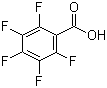
Molecular StructurePentafluorobenzoic acid molecular structure (CAS 602-94-8)
Molecular FormulaC7HF5O2
Molecular Weight212.07
CAS Registry Number602-94-8
EC Number210-026-6
SMILESC1(=C(C(=C(C(=C1F)F)F)F)F)C(=O)O
Properties
Density1.7±0.1 g/cm3 Calc.*
Melting point100 - 102 °C (Expl.)
Boiling point220.0±35.0 °C 760 mmHg (Calc.)*, 220 °C (Expl.)
Flash point86.9±25.9 °C (Calc.)*
Index of refraction1.451 (Calc.)*
*Calculated using Advanced Chemistry Development (ACD/Labs) Software.
Safety Data
Hazard Symbolssymbol symbol   GHS06;GHS07 Danger  Details
Risk StatementsH301-H302-H315-H319-H335  Details
Safety StatementsP261-P264-P264+P265-P270-P271-P280-P301+P316-P301+P317-P302+P352-P304+P340-P305+P351+P338-P319-P321-P330-P332+P317-P337+P317-P362+P364-P403+P233-P405-P501  Details
Hazard Classification
up    Details
HazardClassCategory CodeHazard Statement
Eye irritationEye Irrit.2H319
Skin irritationSkin Irrit.2H315
Specific target organ toxicity - single exposureSTOT SE3H335
Acute toxicityAcute Tox.3H301
Acute toxicityAcute Tox.4H302
Transport InformationUN 2811
SDSAvailable
up chemBlink Chemical Story
Pentafluorobenzoic acid places a carboxylic acid on a benzene ring whose five remaining positions carry fluorine. Its formula, C₇HF₅O₂, includes one hydrogen on the acid function but no aromatic carbon–hydrogen bond. It therefore differs from pentafluorobenzene, in which the only hydrogen is attached directly to the ring. The extra carbon and two oxygens are not an incidental extension: they provide an acid group and a route to a different class of reactions.

The acid can form a carboxylate by losing a proton. That change preserves the carbon framework, whereas decarboxylation removes the carboxyl carbon as carbon dioxide. Confusing the two would mistake a reversible acid–base change for a transformation that changes the molecule's composition. The fluorinated ring and the carboxyl group need to be followed separately when interpreting the products.

Fu, Savage and Lu studied hydrothermal decarboxylation of this compound in 2009. Their investigation varied starting concentration, reaction time and temperature to characterize the reaction kinetics. The reported behavior was first order under the studied conditions, and the temperature dependence followed an Arrhenius relationship. Importantly, the authors observed decarboxylation without evidence of dehalogenation. The disappearance of the starting acid therefore did not imply removal of fluorine from the aromatic framework.

That distinction has broader relevance when discussing fluorinated-material transformations. Breaking the bond that connects a carboxyl group to a ring and breaking carbon–fluorine bonds are different chemical events. A reaction can consume a starting fluorinated compound while retaining its fluorinated portion in the product. Monitoring starting-material loss alone cannot establish the fate of every element.

The kinetic result also has a defined scope. First-order behavior describes the concentration dependence observed in that experimental regime; it does not by itself identify every elementary step or establish the rate in a different solvent and temperature range. The paper supplies a concrete study of transformation rather than a universal stability rating.

This makes pentafluorobenzoic acid an instructive synthetic and mechanistic subject: an acidic terminus can be ionized or removed, while the highly fluorinated ring remains a separately identifiable part of the chemistry. Its value lies in distinguishing those operations precisely rather than treating all changes to a fluorinated molecule as equivalent.

References:
1. PubChem. Pentafluorobenzoic acid, CID 11770. https://pubchem.ncbi.nlm.nih.gov/compound/11770
2. Fu J, Savage PE, Lu X. Hydrothermal decarboxylation of pentafluorobenzoic acid and quinolinic acid. Ind Eng Chem Res. 2009;48:10467–10471. https://doi.org/10.1021/ie901182y

Market Analysis Reports
Related Products
2,3,4,5,6-Penta...  Pentafluoro-Ars...  2,3,4,5,6-Penta...  Pentafluorobenz...  2,3,4,5,6-Penta...  Pentafluorobenz...  Pentafluorobenz...  Pentafluorobenz...  Pentafluorobenz...  2,3,4,5,6-Penta...  Pentafluorobenz...  2 3 4 5 6-Penta...  Pentafluorobenz...  Pentafluorobenz...  Pentafluorobenz...  N-Pentafluorobe...  N-Pentafluorobe...  N-Pentafluorobe...  2-(Pentafluorob...  3-(Pentafluorob...