
Online Database of Chemicals from Around the World
| Simagchem Corporation | China | |||
|---|---|---|---|---|
 | www.simagchem.com | |||
 | +86 13806087780 | |||
 | +86 (592) 268-0237 | |||
 | sale@simagchem.com | |||
| Chemical manufacturer since 2002 | ||||
| chemBlink Standard supplier since 2008 | ||||
| Wuhan Carnoss Technology Co., Ltd. | China | |||
|---|---|---|---|---|
| www.carnoss.com | |||
| +86 18064039730 | |||
| +86 (27) 8349-6462 | |||
| frank@carnosschem.com | |||
 | WeChat: kanuosi_wxid | |||
| Chemical manufacturer since 2012 | ||||
| chemBlink Standard supplier since 2018 | ||||
| Classification | Chemical reagent >> Organic reagent >> Imide |
|---|---|
| Name | N-Benzothiazol-2-ylsulfanyl-N-tert-butyl-benzothiazole-2-sulfenamide |
| Synonyms | N-(2-Benzothiazolylthio)-N-(1,1-dimethylethyl)-2-benzothiazolesulfenamide; Vulcanization Accelerator |
| Molecular Structure | 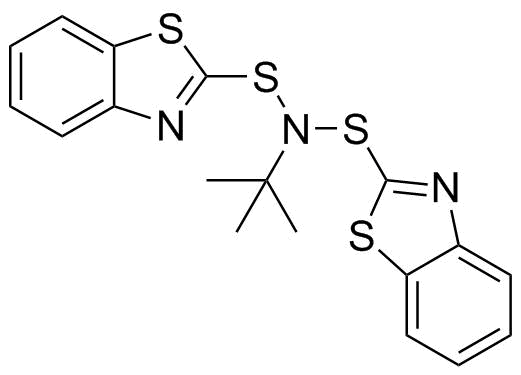 |
| Molecular Formula | C18H17N3S4 |
| Molecular Weight | 403.60 |
| CAS Registry Number | 3741-80-8 |
| EC Number | 407-430-1 |
| SMILES | CC(C)(C)N(SC1=NC2=CC=CC=C2S1)SC3=NC4=CC=CC=C4S3 |
| Density | 1.4±0.1 g/cm3 Calc.* |
|---|---|
| Boiling point | 545.8±33.0 °C 760 mmHg (Calc.)* |
| Flash point | 283.9±25.4 °C (Calc.)* |
| Index of refraction | 1.762 (Calc.)* |
| * | Calculated using Advanced Chemistry Development (ACD/Labs) Software. |
| Hazard Symbols |  GHS09 Warning Details GHS09 Warning Details | ||||||||||||
|---|---|---|---|---|---|---|---|---|---|---|---|---|---|
| Risk Statements | H400-H410 Details | ||||||||||||
| Safety Statements | P273-P391-P501 Details | ||||||||||||
| Hazard Classification | |||||||||||||
| |||||||||||||
 chemBlink Chemical Story
|
Rubber vulcanization is a timing problem as much as a crosslinking problem. A rubber compound must remain processable while it is mixed, extruded, or molded, yet once heated in the mold it must crosslink efficiently and predictably. TBSI, CAS 3741-80-8, belongs to the sulfenamide accelerator family developed to control that balance. Its long systematic name hides a practical purpose: delay premature cure, then provide useful sulfur-vulcanization activity when heat is applied. Uncured rubber is a collection of long, mobile polymer chains. Sulfur vulcanization creates crosslinks between chains, turning a soft, tacky material into an elastic network. Sulfur alone reacts too slowly and inefficiently for most modern manufacturing, so accelerators and activators are used to control sulfur chemistry. Benzothiazole-derived accelerators became especially important because they can generate sulfurating species with useful selectivity. Sulfenamides add a further feature: they are relatively slow at lower processing temperatures but become active during cure. TBSI is unusual among common delayed-action accelerators because its nitrogen is connected to two benzothiazolylsulfenyl groups and a tert-butyl substituent. Industrial literature describes it as a delayed-action accelerator intended to provide scorch safety together with efficient cure. "Scorch" is premature vulcanization during mixing or shaping; once a batch begins to crosslink too early, viscosity rises and the material can no longer flow correctly into a mold. Extra induction time can therefore be economically as important as ultimate tensile strength. The chemistry also shows why accelerator choice affects more than cure speed. Crosslink density and sulfur crosslink structure influence modulus, heat build-up, fatigue, aging, and reversion resistance. Tire compounds, for example, must balance processing safety with demanding dynamic properties. Accelerator systems are consequently chosen as packages rather than isolated ingredients, with sulfur level, zinc activators, temperature, polymer type, and reinforcing fillers all affecting the final network. Delayed action is especially valuable in thick rubber articles because temperature is never perfectly uniform. The outside of a component may heat before its center, and an accelerator that reacts too readily can create gradients in cure state. Formulators therefore evaluate scorch time, optimum cure time, torque development, and final physical properties together. TBSI belongs to a class of ingredients whose value can only be judged from an entire cure curve, not from a single statement that it is "fast" or "slow." Manufacturing kinetics are part of material design. TBSI matters because it represents chemical control of a manufacturing window. Vulcanization cannot start too soon, too late, or proceed in the wrong way. A delayed-action accelerator stores sulfur-reactive potential during processing and releases it under curing conditions. The molecule's significance is therefore not simply that it "accelerates rubber." It helps separate two operations that industry needs to keep distinct: first shape the polymer, then lock that shape into an elastic network. References: 1. ECHA. Substance information for N-tert-butyl-di(2-benzothiazolesulfen)amide (TBSI), CAS 3741-80-8. 2. Akiba M, Hashim AS. Progress in Polymer Science. 1997;22:475-521. DOI: 10.1016/S0079-6700(96)00015-9. 3. Coran AY. Vulcanization. In: Science and Technology of Rubber, 4th ed. DOI: 10.1016/B978-0-12-394584-6.00007-8. 4. Industrial technical literature for TBSI delayed-action rubber accelerator. |
| Market Analysis Reports |