
Online Database of Chemicals from Around the World
| Shanghai Lingde Chemical Technology Co., Ltd. | China | |||
|---|---|---|---|---|
 | www.shldchem.com | |||
 | +86 (21) 5833-3929 | |||
 | +86 (21) 6111-6233 | |||
 | sales@shldchem.com | |||
| Chemical manufacturer | ||||
| chemBlink Standard supplier since 2008 | ||||
| Discovery Fine Chemicals Ltd. | UK | |||
|---|---|---|---|---|
| www.discofinechem.com | |||
| +44 (1202) 874-517 | |||
| +44 (845) 094-4385 | |||
| pjc@discofinechem.com | |||
| Chemical manufacturer | ||||
| chemBlink Standard supplier since 2009 | ||||
| Hefei TNJ Chemical Industry Co., Ltd. | China | |||
|---|---|---|---|---|
| www.tnjchem.com | |||
| +86 (551) 6541-8684 | |||
| +86 (551) 6541-8697 | |||
| sales@tnjchem.com | |||
| Chemical manufacturer since 2001 | ||||
| chemBlink Standard supplier since 2010 | ||||
| Hangzhou Leap Chem Co., Ltd. | China | |||
|---|---|---|---|---|
| www.leapchem.com | |||
| +86 (571) 8771-1850 | |||
| market19@leapchem.com | |||
 | QQ Chat | |||
| Chemical manufacturer since 2006 | ||||
| chemBlink Standard supplier since 2015 | ||||
| Neostar United (Changzhou) Industrial Co., Ltd. | China | |||
|---|---|---|---|---|
| www.neostarunited.com | |||
| +86 (519) 8555-7386 +86 18015025600 | |||
| +86 (519) 8555-7389 | |||
| marketing1@neostarunited.com | |||
| Chemical distributor since 2014 | ||||
| chemBlink Standard supplier since 2020 | ||||
| Guizhou Jianye Yongrong Technology Co., Ltd. (Changzhou Huadong Chemical Research Institute) | China | |||
|---|---|---|---|---|
| www.huadongchem.com | |||
| +86 +13851563211 | |||
| +86 (519) 8261-6386 | |||
| sales@huadongchem.com | |||
 | WeChat: +13851563211 | |||
| Chemical manufacturer since 1999 | ||||
| chemBlink Standard supplier since 2025 | ||||
| Santa Cruz Biotechnology, Inc. | USA | |||
|---|---|---|---|---|
| www.scbt.com | |||
| +1 (831) 457-3800 | |||
| +1 (831) 457-3801 | |||
| scbt@scbt.com | |||
| Chemical manufacturer | ||||
| Strem Chemicals, Inc. | USA | |||
|---|---|---|---|---|
| www.strem.com | |||
| +1 (978) 499-1600 | |||
| +1 (978) 465-3104 | |||
| info@strem.com | |||
| Chemical manufacturer | ||||
| Zhejiang Xianju Application Chemical Research Institute | China | |||
|---|---|---|---|---|
| www.chemptc.com | |||
| +86 (576) 8768-8839 8760-1639 8768-9177 | |||
| +86 (576) 8768-8808 | |||
| lucychen@chemrole.com | |||
| Chemical manufacturer since 1993 | ||||
| Classification | Surfactant >> Cationic surfactant >> Quaternary ammonium salt type |
|---|---|
| Name | Tetrabutylammonium perchlorate |
| Molecular Structure | 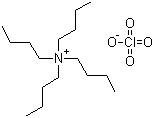 |
| Molecular Formula | C16H36N.ClO4 |
| Molecular Weight | 341.92 |
| CAS Registry Number | 1923-70-2 |
| EC Number | 217-655-5 |
| SMILES | CCCC[N+](CCCC)(CCCC)CCCC.[O-]Cl(=O)(=O)=O |
| Solubility | soluble (ethanol), very slightly soluble (water) (Expl/) |
|---|---|
| Melting point | 210-217 °C (Expl.) |
| Hazard Symbols |   GHS03;GHS07 Danger Details GHS03;GHS07 Danger Details | ||||||||||||||||||||||||
|---|---|---|---|---|---|---|---|---|---|---|---|---|---|---|---|---|---|---|---|---|---|---|---|---|---|
| Risk Statements | H272-H315-H319-H335 Details | ||||||||||||||||||||||||
| Safety Statements | P210-P220-P261-P264-P264+P265-P271-P280-P302+P352-P304+P340-P305+P351+P338-P319-P321-P332+P317-P337+P317-P362+P364-P370+P378-P403+P233-P405-P501 Details | ||||||||||||||||||||||||
| Hazard Classification | |||||||||||||||||||||||||
| |||||||||||||||||||||||||
| Transport Information | UN 1479 | ||||||||||||||||||||||||
| SDS | Available | ||||||||||||||||||||||||
 chemBlink Chemical Story
|
Tetrabutylammonium perchlorate (C16H36NClO4) is a quaternary ammonium salt composed of a tetrabutylammonium cation (C4H9)4N+ and a perchlorate anion (ClO4−). It is typically synthesized by reacting tetrabutylammonium hydroxide with perchloric acid or sodium perchlorate. The resulting compound is a white crystalline solid that is soluble in polar solvents like water, methanol, and acetonitrile. Tetrabutylammonium perchlorate is primarily utilized in research and industrial applications as a phase-transfer catalyst. In organic chemistry, phase-transfer catalysts facilitate the transfer of reactants between immiscible phases, such as an aqueous and an organic phase. By aiding in the transfer of anions, such as halides or perchlorates, from the aqueous to the organic phase, it significantly enhances reaction rates, especially in nucleophilic substitution reactions. The compound has also been used in electrochemical applications, particularly in the development of ionic liquids and electrolytes for electrochemical cells. Due to its high ionic conductivity and stability, tetrabutylammonium perchlorate has found use in the design of lithium-ion and other types of batteries, where it can improve the efficiency of energy storage and conversion processes. Additionally, tetrabutylammonium perchlorate is employed in the preparation of other specialized chemicals and reagents. It is commonly used in the synthesis of perchlorate salts of various organic cations, which can be used in a wide range of chemical reactions. Its role as a reagent in organic synthesis has been documented in various studies, where it serves as a source of perchlorate ions in reactions that require these anions. In conclusion, tetrabutylammonium perchlorate is a versatile chemical compound with applications in organic synthesis, phase-transfer catalysis, and electrochemical systems. Its ability to facilitate reactions involving immiscible phases and its role in enhancing the ionic conductivity of electrolytes make it valuable in both research and industrial processes. References 2024. Investigation of the Combination of Indoline and Naphthalimide in the Preparation of Photosensitizers for Photovoltaic Devices. Journal of Electronic Materials, 53(11). DOI: 10.1007/s11664-024-11538-3 2024. Electrochemical Conversion of Triclosan as a Greener Alternative to Chemical Oxidation. Electrocatalysis, 15(5). DOI: 10.1007/s12678-024-00892-9 2010. A photo- and electrochemically-active porphyrin-fullerene dyad electropolymer. Photochemical & Photobiological Sciences, 9(6). DOI: 10.1039/c0pp00013b |
| Market Analysis Reports |